Enzymatic Hydrolysis: the insoluble fraction is not a residue
Upcyclink’s hands-on perspective on valorizing food by-products through enzymatic hydrolysis.
In enzymatic hydrolysis projects, attention often focuses on the hydrolysate. The liquid. The soluble fraction. The part that is quickly measured: solubilized nitrogen, peptides, amino acids, dry matter, stability, yield. And that makes sense, because the hydrolysate is often the target product. It may be directed toward pet food, aquaculture, agronomy, animal nutrition, or other technical applications.
But that is only one part of the process.
At the end of a hydrolysis step, there is almost always an insoluble fraction left over. Depending on the equipment, it may end up as tank bottom, centrifuge cake, sieve reject, or a fibrous fraction after separation. It is often assessed too quickly. Sometimes as a residue. Sometimes as a constraint. Rarely as a material to be qualified. Yet that is precisely where part of the industrial balance is decided.
Why the insoluble fraction resists
An enzyme acts on what it can reach. Proteases hydrolyze accessible peptide bonds under controlled water, temperature, and pH conditions. What they do not transform is not necessarily “poorly hydrolyzed” material. It is often a less accessible structure.
Organized collagen. Mineral phase. Cell walls. Fibrous matrices.
These architectures do not disappear simply because an enzyme is added. Their resistance comes from the material itself: its composition, organization, density, and accessibility. This is not necessarily a failure of hydrolysis, but also a form of selectivity. The enzyme solubilizes certain molecular families and leaves others in the cake. This fraction may be enriched in minerals, fibers, chitin, or more stable structures. It may also concentrate constraints such as residual lipids, salts, contaminants, odor, moisture, and heterogeneity.
Looking only at the liquid distorts the picture
The hydrolysate yield gives a first indication of how the process is working. Then the full mass balance is examined, and the reading changes.
The centrifuge sometimes produces a solid that is still very water-rich. A fraction of fish bones may retain residual lipids that make preservation difficult. A shell may appear clean, then the odor returns when it is rehydrated. An algae fiber may dry poorly because it retains salt, water, and fine particles. The problem appears in the tank, the dryer, storage, or the next batch.
As long as the mass balance does not clearly distinguish what goes into solution, what remains insoluble, what water is retained, what is lost, and what exits the system, hydrolysis yield tells only part of the story. The liquid may be interesting, but the model can remain fragile if the solid has not been quantified.
Calling an unqualified material “residue” closes the discussion
Residue, reject, tank bottom, secondary by-product: depending on the term used, the decision is sometimes already made before the material has even been analyzed.
An insoluble fraction is not automatically waste. It can become a product, an intermediate material, a technical load, a fraction with agronomic potential, or simply a fallback route. These statuses are not equivalent. But each requires one thing: knowing what you actually have in hand.
For marine by-products, the questions are very concrete: calcium, phosphorus, residual organic matter, lipids, salt, sand, odor, moisture, particle size, cross-contamination. Without this reading, we are not yet talking about valorization. Because the issue is not the existence of the insoluble fraction, but its lack of industrial status.
Three families, three logics
What marine biomasses reveal.
Bones and mineral structures
The skeleton of fish is a composite material: an organic matrix, mainly collagen-based, associated with a mineral phase rich in calcium and phosphorus.
After a carefully controlled hydrolysis, part of the organic matter passes into solution. What remains in the cake may then present a more legible mineral fraction than in the raw by-product. That is not automatically a product; it is a material to study.
For a bone powder, the useful questions are very concrete: particle size, final moisture, residual lipids, odor, storage stability, contaminants, sanitary status of the raw material, intended use. The distinction matters: a simply ground bone and an insoluble fraction obtained after hydrolysis are not exactly the same material. The first remains a more heterogeneous co-ground product. The second may come from a controlled separation, with a clearer composition and a more precise direction.
Skins and collagen-rich tissues follow a similar logic. What remains in the cake is not always just a loss in yield. It may be a fibrous structure that is still usable, provided it is characterized and shaped appropriately.
Shells and carapaces
Shells account for a very large share of the total weight of some shellfish. They are often directed toward low-value uses: fill material, limestone amendment, mineral filler, or sometimes disposal. These routes may be relevant, but they are not the only ones.
The main limitation of a raw shell is not always its mineral composition. It is what it still carries: organic matter, biofilm, odor, heterogeneity, moisture, impurities. These elements block access to more demanding uses.
Enzymatic treatment can help reduce this residual organic load and produce a cleaner, more stable, more consistent shell. The goal is not necessarily to extract a complex molecule. It can be much simpler: to prepare a higher-quality calcareous fraction. A poorly cleaned shell remains a constraint; a clean shell can become a raw material again.
In aquaculture, for example, demand is not only for an available shell. It is for a clean, regular shell with no strong odor and compatible with a specific technical use. The material exists. The difficult part is often preparation: sorting, cleaning, stabilization, possible grinding, and batch consistency.
Crustacean shells raise another question. After hydrolysis, the insoluble fraction may be enriched in chitin, which is not much affected by classical proteases. That fraction may serve as a starting point for further transformation, especially toward chitosan.
Again, precision matters. A hydrolyzed shell is not purified chitin. It is an intermediate material. Its value will depend on the actual chitin content, residual proteins, mineral load, contaminants, traceability, and the cost of the next steps. So the issue is not only academic. It is industrial: collection, batch quality, consistency, traceability, separation, and scale-up.
Algae and marine fibers
With macroalgae, attention often focuses on the extracted fractions: polysaccharides, pigments, polyphenols, soluble compounds.
The cake is then seen as a separation constraint, which is not always fair.
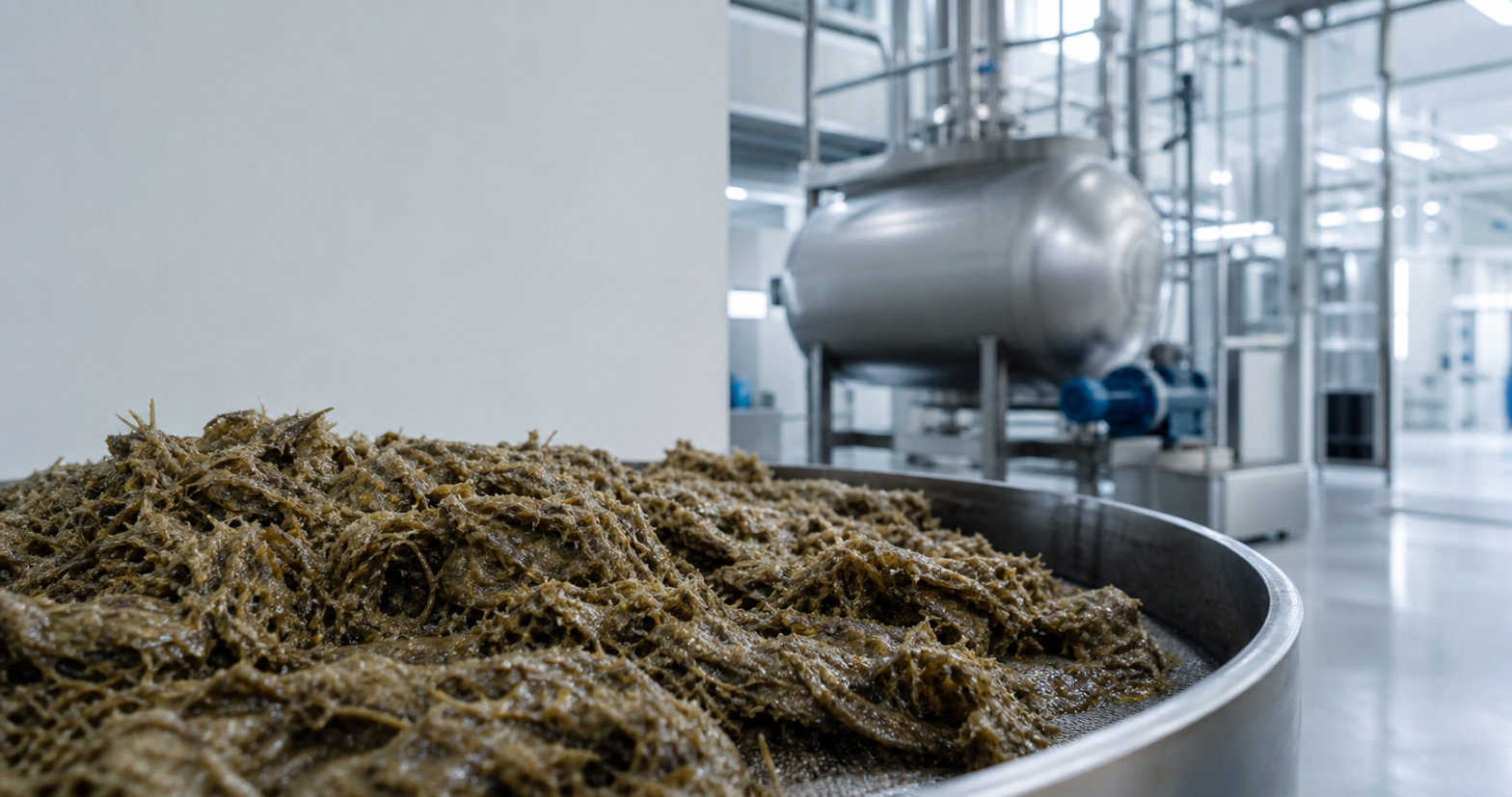
Some cell-wall compounds or fibrous structures are not released in a standard aqueous process. The insoluble fraction can therefore become a pre-concentrate, an intermediate material, or a valorization path in its own right.
Algae fibers may offer interesting properties as a support, matrix, or functional component. But the word “algae” is not enough. Residual salt, fines, sand, moisture, odor, seasonal variability, and drying behavior quickly determine whether the fraction can enter a value chain or remain only a hypothesis. Value does not come from the general potential of algae, but from the actual profile of the batch.
The solid should not be discovered after the trial
If the insoluble fraction is only examined after hydrolysis, part of the cost is already locked in: longer-than-expected drying, unstable grinding, heterogeneous batches, residual odor, difficult storage, uncertain outlet.
The solid then becomes an economic line item. A wet, loaded, irregular, or unstabilized solid may require a different separation, another washing step, another drying step, another outlet. Sometimes none at all.
The right question is therefore not only: did hydrolysis produce a good hydrolysate? The full question is: what did the process produce, liquid and solid, and which fraction truly has industrial status?
What we look at at Upcyclink
During a hydrolysis trial, we do not look only at the liquid obtained. We look at the full mass balance.
How much mass goes into the hydrolysate? How much remains insoluble? How much water does that fraction retain? Can it be washed, dried, ground, stored? Does it have a credible industrial outlet? Or must it be treated as a process cost?
This approach avoids describing a trial as a success too quickly just because the liquid is interesting, while the remaining solid still has no clear status.
At Upcyclink, we approach enzymatic hydrolysis as a fractionation tool. The goal is not only to produce a hydrolysate, but to understand what becomes of the entire incoming biomass and to build a coherent direction for each fraction.
Conclusion
The insoluble fraction is not emptiness; it is a material.
It may carry value. It may also carry cost. It all depends on its actual state, cleanliness, stability, outlet, and the price that must be paid to make it usable.
A process should not be judged by a single output. It should be judged by the full mass balance. Otherwise, part of the value may remain in the filter.